.png)
Scenes of Summer: A Visual History of Bald Head Island
Updated: Jun 5
For more than a century, photographs and works of art depicting Bald Head Island have documented not only changing landscapes, but also the evolving story of the people who lived, worked, visited, and found community here. Preserved together, these images offer a visual timeline of island life and remind us how deeply history is tied to place. From early tourism and recreation to wartime activity, environmental traditions, and modern community celebrations, each photograph captures a moment that contributes to the broader story of Bald Head Island and the continued preservation of its history through the work of the Old Baldy Foundation.

The visual story of summer on Bald Head Island begins even before Old Baldy itself. A rare drawing dated July 24, 1806, depicts a waterspout at the mouth of the Cape Fear River alongside the original Bald Head Lighthouse and keeper’s cottage. Built in the 1790’s, the original lighthouse would later be replaced by Old Baldy in 1817. As one of the only surviving depiction of the first lighthouse, the drawing offers an important glimpse into the earliest chapter of Bald Head Island’s maritime history and the long story of preservation that continues today.

More early images in our collection date to the early 1900s, when Bald Head Island was referred to as “Palmetto Island.” A 1909 postcard presents the island as a remote coastal destination, advertised for its natural beauty and growing appeal to visitors arriving from the mainland. By the 1920s, postcards depicting beachgoers enjoying the surf reflected the increasing popularity of coastal tourism in North Carolina and the role barrier islands played in shaping regional leisure culture during the early twentieth century.


Photographs from roughly 1916 to 1920 further document recreational life on the island. In one image with the words "Bathing Palmetto Island..." written on it, a group of boys swims in the ocean along Bald Head’s shoreline. In another, two women stand in the water with Old Baldy Lighthouse visible behind them. While casual in nature, these photographs are valuable historical records. They capture everyday moments while also documenting the enduring presence of Old Baldy as a defining landmark within the island landscape. Long after its decommissioning as a lighthouse, the structure remained a recognizable and meaningful part of island life.

By the late 1930s, photographs such as the image of Dorothy Hardee and Leila Pigott clamming in Buzzard Bay document the connection between locals and the island’s coastal environment. Activities like clamming, fishing, and navigating tidal creeks were not only recreational traditions, but also part of the practical rhythms of life along the Cape Fear coast. Images like these preserve aspects of regional culture and coastal heritage that might otherwise be lost over time.


The island also played a role in broader national history during World War II. Among the photographs preserved from this era is an image of servicemen and residents from nearby Southport posed on Bald Head's beach, reflecting the community presence and coastal defense efforts that shaped North Carolina's shoreline during the war years. During this period, patrols along the coast, including on Bald Head Island, were part of broader efforts to monitor for German U-boats operating off the North Carolina coast. Another image from April 1940 captures a quieter personal moment, a woman posing along the shoreline, offering a reminder that even during periods of global uncertainty, daily life and recreation continued on the island.
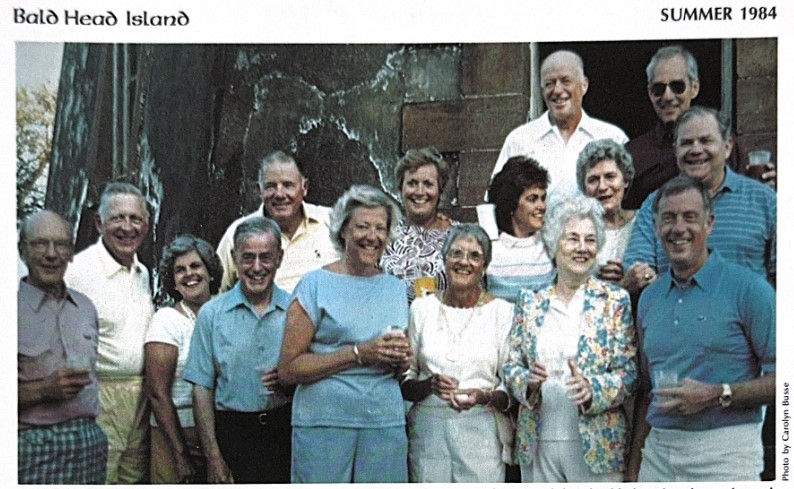
As Bald Head Island changed throughout the second half of the twentieth century, photographs continued to document the evolution of the area. A 1984 photograph of the Generator Society gathered outside Old Baldy commemorates residents who experienced the island prior to modern infrastructure development, including paved roads, the marina, and widespread utilities, like electricity. Their gathering reflected a growing awareness of the importance of preserving both the physical landmarks and personal memories associated with Bald Head Island’s earlier years.

The island’s layered history continued to reveal itself in 2001, when construction worker James Brown uncovered a projectile from a Lyle gun on South Beach. The artifact, connected to the Cape Fear Life Saving Station, serves as a reminder of the life-saving crews stationed along the coast before the establishment of the modern Coast Guard. Discoveries such as this demonstrate how archaeology and preservation efforts continue to deepen our understanding of the island’s maritime history.

The final photograph in this series brings the story into the present day. Participants in the Old Baldy Foundation’s 2025 Fourth of July Golf Cart Parade celebrate a modern island tradition rooted in community gathering and shared history. While the island continues to evolve, these annual events reflect the ongoing importance of preserving cultural traditions alongside historic structures and artifacts.
As the Old Baldy Foundation prepares for another busy summer season, we remain committed to preserving and sharing the many stories that shape Bald Head Island’s history. This year’s summer calendar includes a special America 250-themed edition of the annual Fourth of July Golf Cart Parade, along with additional programs and events focused on local history, education, and community engagement. To learn more about upcoming events and summer programming, visit oldbaldy.org/events.



Comments